
Zaid Ahmed, 22

Championing Underdogs: How Zaid Ahmed Empowers Every Aspiring Builder
When Zaid Ahmed founded Hack the Bias, his goal was simple: build a hackathon specifically for the underdogs and newbies who just needed a safe place to start.
Entering software engineering at the University of Calgary without a clear picture of what lay ahead, his journey into coding was anything but a straight line. In the beginning, he felt behind everyone else in his classes. But everything shifted once he realized programming wasn't just a technical skill to acquire, but a tool to help others. That shift from "learning to code" to "coding to help people" was when everything clicked, setting him on a path to break down barriers and empower the next generation of hackers.
Zaid’s own entry into the hacker community, in his own words, “was a disaster.” Stepping into his first hackathon at Hack the Change 2022, he admits, "I didn't really know how to program before my first hackathon." Between car trouble and insufficient time management, his team failed to upload a video in time, leaving them without a project submission. While many others on his team decided this was not the space for them, Zaid couldn't let it go. Powered by the frustration of an incomplete project, he signed up for more events. Through events like HackGT and Reality Hack at MIT, he learned to scope realistically, integrate early, and build under pressure.
Determined to give others a smoother entry point, Zaid launched Hack the Bias as a space accessible to beginners without intimidation. Zaid and his team put immense care into the event, reviewing every application by hand to make sure participants were properly tiered so all judging would be fair. Running on little sleep and strong tea, the event was a success. Competitors came in as beginners and walked away with working projects and new friends. As Zaid highlights, "We created something that felt less like a competition and more like a massive gathering of pals, even when things broke. Watching teams present projects that tackled bias in healthcare, hiring, and education was one of the proudest moments I've had in this community." Zaid continues to champion the movement as an advisor to ensure the event remains a welcoming launching pad for future generations.
Strengthening his mission of fostering welcoming communities, Zaid helped run STEM workshops through Robogals UCalgary. As VP Special Projects, he helped organize free workshops that guided young learners through engineering, coding, and robotics in a supportive environment. "It’s about showing up consistently for people who haven’t decided yet if tech is for them."
He continues to attend hackathons and views every event as a learning experience; while he has 7 hackathon wins under his belt, he actively highlights his 8 losses. Focusing on building tools for those overlooked by mainstream tech, he built BraVRy, a Virtual Reality exposure therapy platform to relieve anxiety that took 2nd place at natHacks 2023. He also built Swipe-Talk, a gesture-tracking application using the Microsoft HoloLens 2 and Unity Editor for individuals with limited motor control, earning 1st place at the IEEE SIGHT ProjectVoice Hackathon. His project AutoLeARn delivers real-time interactive AR car maintenance using Groq’s AI models for car detail extraction and repair instructions, integrating Perplexity research-based reasoning and video tutorials. As Zaid emphasizes, "The through-line across everything I do is the same: I want the people who feel most excluded from tech to be the ones who benefit from it the most."
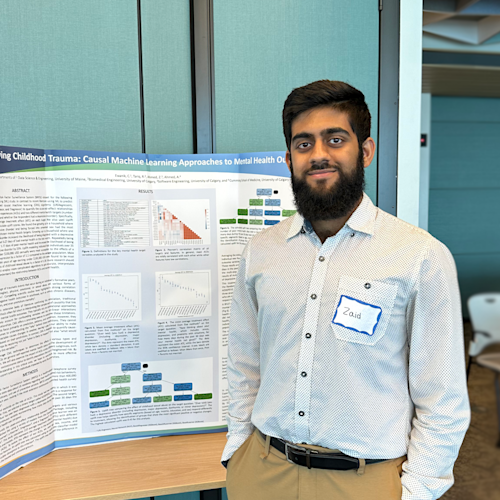
Zaid keeps himself grounded through Brazilian jiu-jitsu, humorously noting that he is "comfortably one of the worst people at my gym." At the University of Calgary, he worked as a researcher in the Human-X Interaction Lab under Dr. Kangsoo Kim, where his work sat at the intersection of VR, AR, and human-centered design, and resulted in 3 undergraduate research publications. Now pursuing his Master's in Computer Science at the University of Waterloo, he continues his research and remains active in the hackathon community. Zaid is proof that you don't have to stay in a single lane. As he puts it, "I want to show people they don't have to fit into one box to belong here."
Quick Facts
Zaid Ahmed, 22
Championing Underdogs: How Zaid Ahmed Empowers Every Aspiring Builder
When Zaid Ahmed founded Hack the Bias, his goal was simple: build a hackathon specifically for the underdogs and newbies who just needed a safe place to start.
Entering software engineering at the University of Calgary without a clear picture of what lay ahead, his journey into coding was anything but a straight line. In the beginning, he felt behind everyone else in his classes. But everything shifted once he realized programming wasn't just a technical skill to acquire, but a tool to help others. That shift from "learning to code" to "coding to help people" was when everything clicked, setting him on a path to break down barriers and empower the next generation of hackers.
Zaid’s own entry into the hacker community, in his own words, “was a disaster.” Stepping into his first hackathon at Hack the Change 2022, he admits, "I didn't really know how to program before my first hackathon." Between car trouble and insufficient time management, his team failed to upload a video in time, leaving them without a project submission. While many others on his team decided this was not the space for them, Zaid couldn't let it go. Powered by the frustration of an incomplete project, he signed up for more events. Through events like HackGT and Reality Hack at MIT, he learned to scope realistically, integrate early, and build under pressure.
Determined to give others a smoother entry point, Zaid launched Hack the Bias as a space accessible to beginners without intimidation. Zaid and his team put immense care into the event, reviewing every application by hand to make sure participants were properly tiered so all judging would be fair. Running on little sleep and strong tea, the event was a success. Competitors came in as beginners and walked away with working projects and new friends. As Zaid highlights, "We created something that felt less like a competition and more like a massive gathering of pals, even when things broke. Watching teams present projects that tackled bias in healthcare, hiring, and education was one of the proudest moments I've had in this community." Zaid continues to champion the movement as an advisor to ensure the event remains a welcoming launching pad for future generations.
Strengthening his mission of fostering welcoming communities, Zaid helped run STEM workshops through Robogals UCalgary. As VP Special Projects, he helped organize free workshops that guided young learners through engineering, coding, and robotics in a supportive environment. "It’s about showing up consistently for people who haven’t decided yet if tech is for them."
He continues to attend hackathons and views every event as a learning experience; while he has 7 hackathon wins under his belt, he actively highlights his 8 losses. Focusing on building tools for those overlooked by mainstream tech, he built BraVRy, a Virtual Reality exposure therapy platform to relieve anxiety that took 2nd place at natHacks 2023. He also built Swipe-Talk, a gesture-tracking application using the Microsoft HoloLens 2 and Unity Editor for individuals with limited motor control, earning 1st place at the IEEE SIGHT ProjectVoice Hackathon. His project AutoLeARn delivers real-time interactive AR car maintenance using Groq’s AI models for car detail extraction and repair instructions, integrating Perplexity research-based reasoning and video tutorials. As Zaid emphasizes, "The through-line across everything I do is the same: I want the people who feel most excluded from tech to be the ones who benefit from it the most."
Zaid keeps himself grounded through Brazilian jiu-jitsu, humorously noting that he is "comfortably one of the worst people at my gym." At the University of Calgary, he worked as a researcher in the Human-X Interaction Lab under Dr. Kangsoo Kim, where his work sat at the intersection of VR, AR, and human-centered design, and resulted in 3 undergraduate research publications. Now pursuing his Master's in Computer Science at the University of Waterloo, he continues his research and remains active in the hackathon community. Zaid is proof that you don't have to stay in a single lane. As he puts it, "I want to show people they don't have to fit into one box to belong here."


