
Mateo Taylor, 20
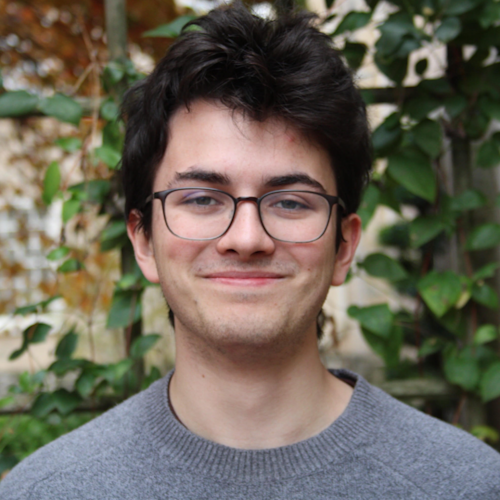

Mateo Taylor: From Dungeon Master to Sociologist Hacker, Mapping the Social Fabric of Hackathons
Mateo Taylor’s affinity for world-building and storytelling has provided him with an unexpected journey, but set him on the path he was meant to pursue. He entered Haverford College as a sociology major. In his first semester, he ended up taking an introduction to computer science class as an elective and this unlocked a whole new realm of creativity. Inspired by software's potential for collaborative creation, Mateo spent his winter break constructing a custom website to help him and his friends play Dungeons & Dragons. He often served as his party’s Game Master, creating their campaigns. Programming clicked immediately as a digital extension of world-building. Watching real people interact with his creations sparked a passion that drove him straight into tech and a double major in Computer Science and Sociology.
This naturally led him to hackathons. When his school’s hackathon was delayed during his sophomore year, Mateo naively searched online for local options and landed at a January 2025 machine learning contest hosted by Columbia University’s environmental school. Teaming up with a PhD student, a retired AWS engineer, and an electrical engineering master's student, the eclectic crew lost the competition but forged lasting friendships. Mateo continued chasing that momentum and attended his first full-scale hackathon, Bitcamp 2025 at the University of Maryland. Coming from a small liberal arts computer science department, these weekend hackathons opened the door to a nationwide community of passionate builders.
Leaving Bitcamp, Mateo realized he was witnessing an extraordinary real-world narrative: “I left wishing I could properly decode the 36 hours of social phenomena that I’d just witnessed. Never before had I seen a display of companionable shared interest, with 1000+ people from across the country so willingly collaborating and jumping headfirst into projects.” He asked his Sociology advisor if he could spend his fall semester working on a hackathon research project. The department approved his pitch, leading Mateo to attend hackathons across the east coast - compiling field notes and interviewing student organizers. The initiative quickly grew far larger than anticipated: “I’m now working on writing (and hopefully publishing!) my senior thesis on hackathons…” he explains. “In particular, I’m focused on understanding what motivates students to travel long distances and attend external hackathons, and I believe that my findings will be a useful tool in helping organizers broaden their outreach to attendees.”
One of his most memorable moments as the unofficial hackathon scribe unfolded during an interview at MakeCU, an MLH-sponsored hardware hackathon at Columbia University. The event was organized by the very same electrical engineering teammate Mateo had met at his first hackathon ten months prior, who invited him out to interview attendees for his research. Looking for a quiet room to record, Mateo found an empty classroom, turned on the overhead lights, and began the interview. “About a minute into recording, we heard some rustling from beneath the tables in the back of the room and watched a bedraggled student (who we’d accidentally woken up) stand up with a sleeping bag in hand,” Mateo recalls. “Without missing a beat, that student excitedly started to follow up on a question I’d just asked the organizer about their hardware. While we watched in surprise, he spent around 30 seconds unpacking his toothbrush and explaining his strong opinions on the differences between dynamixel and feetech motor drivers before leaving the room.”
Back at Haverford, his peers affectionately know him as "the hackathon guy" because he is a constant community advocate, serving as co-head of HaverCode - the campus computer science organization - he regularly floods the group chats with event links to encourages classmates to join the quest. Mateo continues to bring the heart of a Game Master to not just his campaigns but also his educational and professional pursuits. Every step of his journey is a masterclass in collaborative creation.
Quick Facts
Mateo Taylor, 20
Mateo Taylor: From Dungeon Master to Sociologist Hacker, Mapping the Social Fabric of Hackathons
Mateo Taylor’s affinity for world-building and storytelling has provided him with an unexpected journey, but set him on the path he was meant to pursue. He entered Haverford College as a sociology major. In his first semester, he ended up taking an introduction to computer science class as an elective and this unlocked a whole new realm of creativity. Inspired by software's potential for collaborative creation, Mateo spent his winter break constructing a custom website to help him and his friends play Dungeons & Dragons. He often served as his party’s Game Master, creating their campaigns. Programming clicked immediately as a digital extension of world-building. Watching real people interact with his creations sparked a passion that drove him straight into tech and a double major in Computer Science and Sociology.
This naturally led him to hackathons. When his school’s hackathon was delayed during his sophomore year, Mateo naively searched online for local options and landed at a January 2025 machine learning contest hosted by Columbia University’s environmental school. Teaming up with a PhD student, a retired AWS engineer, and an electrical engineering master's student, the eclectic crew lost the competition but forged lasting friendships. Mateo continued chasing that momentum and attended his first full-scale hackathon, Bitcamp 2025 at the University of Maryland. Coming from a small liberal arts computer science department, these weekend hackathons opened the door to a nationwide community of passionate builders.
Leaving Bitcamp, Mateo realized he was witnessing an extraordinary real-world narrative: “I left wishing I could properly decode the 36 hours of social phenomena that I’d just witnessed. Never before had I seen a display of companionable shared interest, with 1000+ people from across the country so willingly collaborating and jumping headfirst into projects.” He asked his Sociology advisor if he could spend his fall semester working on a hackathon research project. The department approved his pitch, leading Mateo to attend hackathons across the east coast - compiling field notes and interviewing student organizers. The initiative quickly grew far larger than anticipated: “I’m now working on writing (and hopefully publishing!) my senior thesis on hackathons…” he explains. “In particular, I’m focused on understanding what motivates students to travel long distances and attend external hackathons, and I believe that my findings will be a useful tool in helping organizers broaden their outreach to attendees.”
One of his most memorable moments as the unofficial hackathon scribe unfolded during an interview at MakeCU, an MLH-sponsored hardware hackathon at Columbia University. The event was organized by the very same electrical engineering teammate Mateo had met at his first hackathon ten months prior, who invited him out to interview attendees for his research. Looking for a quiet room to record, Mateo found an empty classroom, turned on the overhead lights, and began the interview. “About a minute into recording, we heard some rustling from beneath the tables in the back of the room and watched a bedraggled student (who we’d accidentally woken up) stand up with a sleeping bag in hand,” Mateo recalls. “Without missing a beat, that student excitedly started to follow up on a question I’d just asked the organizer about their hardware. While we watched in surprise, he spent around 30 seconds unpacking his toothbrush and explaining his strong opinions on the differences between dynamixel and feetech motor drivers before leaving the room.”
Back at Haverford, his peers affectionately know him as "the hackathon guy" because he is a constant community advocate, serving as co-head of HaverCode - the campus computer science organization - he regularly floods the group chats with event links to encourages classmates to join the quest. Mateo continues to bring the heart of a Game Master to not just his campaigns but also his educational and professional pursuits. Every step of his journey is a masterclass in collaborative creation.


